News
Babine Lake Nation Recycling Program In For The Long Haul
Burn’s Lake Lakes District News
Wednesday, January 14, 2026
Frank Pebbles
Special to LDN
Lake Babine Nation decided to kick recycling to the curb, and now the program is really hauling.
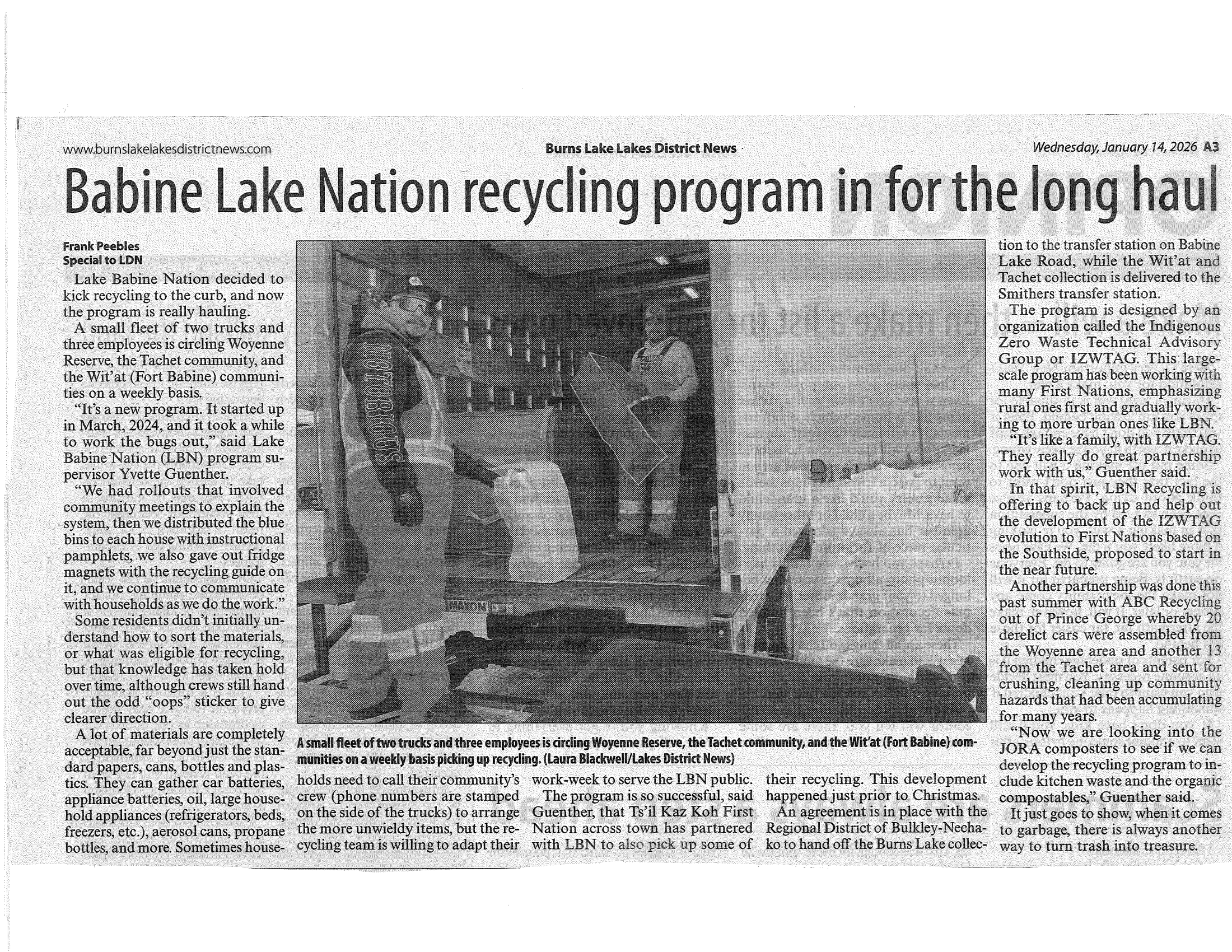
A small fleet of two trucks and three employees is circling Woyenne Reserve, the Tachet community, and the Wit’at (Fort Babine) communities on a weekly basis.
“It’s a new program. It started up in March, 2024, and it took a while to work the bugs out,” said Lake Babine Nation (LBN) program supervisor Yvette Guenther.
“We had rollouts that involved community meetings to explain the system, then we distributed the blue bins to each house with instructional pamphlets, we also gave out fridge magnets with the recycling guide on it, and we continue to communicate with households as we do the work.”
Some residents didn’t initially understand how to sort the materials, or what was eligible for recycling, but that knowledge has taken hold over time, although crews still hand out the odd “oops” sticker to give clearer direction.
A lot of materials are completely acceptable, far beyond just the standard papers, cans, bottles, and plastics. They can gather car batteries, appliance batteries, oil, large household appliances (refrigerators, beds, freezers, etc.), aerosol cans, propane bottles, and more. Sometimes households need to call their community’s crew (phone numbers were stamped on the side of the trucks) to arrange the more unwieldy items, but the recycling team is willing to adapt their work-week to serve the LBN public.
The program is so successful, said Guenther, that Ts’il Kaz Koh First Nation across town has partnered with LBN to also pick up some of their recycling. This development happened just prior to Christmas.
An agreement is in place with the Regional District of Bulkley-Nechako to hand off the Burns Lake collection to the transfer station on Babine Lake Road, while the Wit’at and Tachet collection is delivered to the Smithers transfer station.
The program is designed by an organization called Indigenous Zero Waste Technical Advisory Group or IZWTAG. This large-scale program has been working with many First Nations, emphasizing rural ones first and gradually working to more urban ones like LBN.
“It’s like a family, with IZWTAG. They really do great partnership work with us,” Guenther said.
In that spirit, LBN Recycling is offering to back up and help out the development of the IZWTAG evolution to First Nations based on the Southside, proposed to start in the near future.
Another partnership was done this past summer with ABC Recycling out of Prince George whereby 20 derelict cars were assembled from the Woyenne area and another 13 from the Tachet area and sent for crushing, cleaning up community hazards that had been accumulating for many years.
“Now we are looking into the JORA composters to see if we can develop the recycling program to include kitchen waste and the organic compostables,” Guenther said.
It just goes to show, when it comes to garbage, there is always another way to turn trash into treasure.